


Why Global B2B Companies Struggle in Japan
Japan is one of the world’s largest enterprise markets and one of the easiest to underestimate.
Most companies do not fail because the product is weak.
They struggle because trust has not yet been established, stakeholders are not aligned, and the sales motion lacks the structure required in complex enterprise buying environments.
Lane G.K. helps global B2B companies:
build the positioning, stakeholder alignment, and go-to-market architecture required to win in Japan.

Four Realities of B2B Sales in Japan
1. Trust & Market Credibility:
Japanese enterprise buyers do not purchase based solely on product superiority.
They buy based on confidence in execution, delivery capability, and long-term trust.
Successful companies localize more than messaging. They establish:
-
credible market positioning
-
trusted implementation partners
-
referenceable customer success
-
consistent executive communication
In Japan, trust is not a soft factor — it is a core commercial requirement.
Lane G.K. helps companies:
-
strengthen market credibility
-
refine enterprise positioning
-
Align messaging with buyer expectations
-
to accelerate trust-building in the Japanese market
2. Stakeholder Consensus Alignment
Enterprise buying decisions in Japan are rarely top-down.
Before formal approval, internal stakeholders must first build informal consensus among business, operational, technical, and financial teams.
This process — often shaped through nemawashi — means enterprise sales success depends on:
-
stakeholder mapping
-
internal alignment
-
risk reduction
-
and cross-functional trust
Many global companies focus too heavily on executive presentations while underestimating the influence of middle management and operational teams.
Lane G.K. helps companies:
-
Identify real decision influencers
-
Align stakeholders across the buying ecosystem
-
improve enterprise sales engagement strategy
-
Reduce deal friction and stalled consensus
3. SI partner & local Ecosystem Dynamics
Japan’s enterprise market is deeply relationship-driven and ecosystem-led.
Major Systems Integrators (SIs), implementation partners, and incumbent vendors often influence:
-
solution evaluation
-
buyer confidence
-
implementation trust
-
and long-term vendor selection
Without the right ecosystem strategy, even strong products struggle to gain traction.
Successful market entry requires understanding:
-
Who shapes buyer confidence
-
where influence exists
-
and how partnerships impact enterprise adoption
Lane G.K. helps companies:
-
Develop Japan partner strategies
-
strengthen ecosystem positioning
-
improve SI engagement
-
build local market credibility
4. Enterprise Sales Discipline:
Enterprise sales growth in Japan requires more than activity — it requires disciplined execution.
Many organizations struggle because:
-
qualification standards are inconsistent
-
Stakeholder engagement is incomplete
-
messaging changes during the sales cycle
-
and opportunities lack structured governance
Complex enterprise deals require:
-
clear qualification frameworks
-
executive alignment
-
measurable sales stages
-
and a consistent account strategy
Lane G.K. helps companies:
-
improve sales process discipline
-
strengthen enterprise qualification standards
-
align go-to-market execution
-
and build scalable sales operating frameworks

Why Global B2B Companies Struggle in Japan
Japan is one of the world’s largest enterprise markets and one of the easiest to underestimate.
Most companies do not fail because the product is weak.
They struggle because trust has not yet been established, stakeholders are not aligned, and the sales motion lacks the structure required in complex enterprise buying environments.
Lane G.K. helps global B2B companies:
build the positioning, stakeholder alignment, and go-to-market architecture required to win in Japan.
Four Realities of B2B Sales in Japan
1. Trust & Market Credibility:
Japanese enterprise buyers do not purchase based solely on product superiority.
They buy based on confidence in execution, delivery capability, and long-term trust.
Successful companies localize more than messaging. They establish:
-
credible market positioning
-
trusted implementation partners
-
referenceable customer success
-
consistent executive communication
In Japan, trust is not a soft factor — it is a core commercial requirement.
Lane G.K. helps companies:
-
strengthen market credibility
-
refine enterprise positioning
-
Align messaging with buyer expectations
-
to accelerate trust-building in the Japanese market
2. Stakeholder Consensus Alignment
Enterprise buying decisions in Japan are rarely top-down.
Before formal approval, internal stakeholders must first build informal consensus among business, operational, technical, and financial teams.
This process — often shaped through nemawashi — means enterprise sales success depends on:
-
stakeholder mapping
-
internal alignment
-
risk reduction
-
and cross-functional trust
Many global companies focus too heavily on executive presentations while underestimating the influence of middle management and operational teams.
Lane G.K. helps companies:
-
Identify real decision influencers
-
Align stakeholders across the buying ecosystem
-
improve enterprise sales engagement strategy
-
Reduce deal friction and stalled consensus
3. SI partner & local Ecosystem Dynamics
Japan’s enterprise market is deeply relationship-driven and ecosystem-led.
Major Systems Integrators (SIs), implementation partners, and incumbent vendors often influence:
-
solution evaluation
-
buyer confidence
-
implementation trust
-
and long-term vendor selection
Without the right ecosystem strategy, even strong products struggle to gain traction.
Successful market entry requires understanding:
-
Who shapes buyer confidence
-
where influence exists
-
and how partnerships impact enterprise adoption
Lane G.K. helps companies:
-
Develop Japan partner strategies
-
strengthen ecosystem positioning
-
improve SI engagement
-
build local market credibility
4. Enterprise Sales Discipline:
Enterprise sales growth in Japan requires more than activity — it requires disciplined execution.
Many organizations struggle because:
-
qualification standards are inconsistent
-
Stakeholder engagement is incomplete
-
messaging changes during the sales cycle
-
and opportunities lack structured governance
Complex enterprise deals require:
-
clear qualification frameworks
-
executive alignment
-
measurable sales stages
-
and a consistent account strategy
Lane G.K. helps companies:
-
improve sales process discipline
-
strengthen enterprise qualification standards
-
align go-to-market execution
-
and build scalable sales operating frameworks
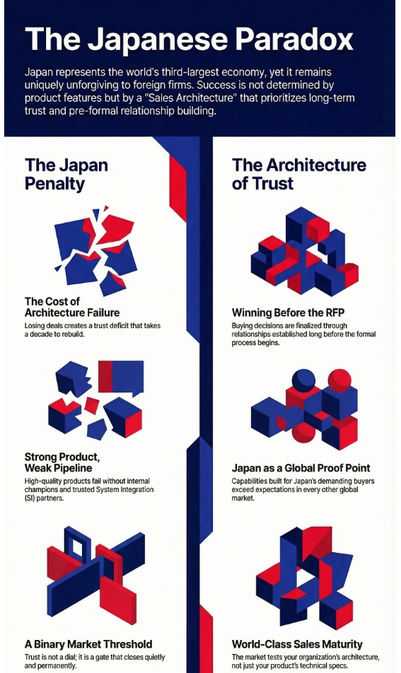
Japan’s Enterprise Sales Paradox:
Strong Products. Weak Pipelines.
Many companies enter Japan with strong products — but weak sales architecture.
The result is predictable:
-
reactive RFP engagement
-
low market trust
-
stalled pipelines
-
and slow enterprise adoption
In Japan, buyers evaluate more than technical capability. They evaluate execution confidence, local credibility, ecosystem trust, and long-term commitment.
Enterprise deals are often won before the formal buying process begins.
By the time an RFP is released:
-
Internal stakeholders are already aligned
-
trusted partners are already influencing decisions
-
And buyer confidence has already been established
This is why Japan can become either:
-
a long-term strategic growth market
-
or a prolonged and expensive market-entry failure
The difference is rarely product quality alone.
It is the sales and market architecture behind the product.
Lane G.K. helps companies:
-
build enterprise trust
-
strengthen Japan market positioning
-
align stakeholders
-
and create scalable go-to-market execution
Who Lane G.K. Serves
Two audiences. One mission.
Global Companies Selling into Japan.
Strong products alone rarely win complex enterprise deals in Japan.
Many companies enter the market with:
-
credible technology
-
proven global success
-
and early customer interest
Yet growth stalls because:
-
Trust is not established early enough
-
Stakeholder consensus remains unclear
-
Sales motion was designed for a different market
Lane G.K. helps companies:
-
strengthen market credibility
-
Align enterprise stakeholders
-
refine Japan go-to-market execution
-
and build a scalable sales architecture for long-term growth
Japanese Companies Growing Abroad.
What succeeds in Japan does not always translate internationally.
Global buyers often expect:
-
clearer business value
-
more direct communication
-
faster decision-making
-
and different stakeholder engagement models
Lane G.K. helps Japanese companies:
-
adapt sales strategy for global markets
-
strengthen international messaging
-
improve stakeholder engagement
-
and build scalable global sales execution

ESOS:
Enterprise Sales Operating System
A strategic framework for building trust, aligning stakeholders, and creating the sales discipline required to win complex enterprise deals in Japan.
The ESOS framework helps companies transition from reactive deal pursuit to scalable market growth.
Pillar 1 — Strategic Messaging & Positioning:
Your value proposition only works if it resonates with the people influencing the decision.
Japanese enterprise buying environments require:
-
localized messaging
-
stakeholder-specific narratives
-
and clear business relevance
Lane G.K. helps companies:
-
refine enterprise positioning
-
localize strategic messaging
-
Align communication across stakeholders
-
and strengthen market credibility
Pillar 2 — Stakeholder & Consensus Mapping:
Enterprise deals in Japan are often won before the formal buying process begins.
Successful organizations identify:
-
key influencers
-
internal champions
-
hidden blockers
-
and the consensus dynamics shaping the decision
Lane G.K. helps companies:
-
map stakeholder ecosystems
-
strengthen internal alignment
-
develop nemawashi strategies
-
and navigate complex enterprise decision-making
Pillar 3 — Sales Blueprint & Deal Discipline:
Complex enterprise deals require structured execution.
Many organizations struggle because qualification standards, stakeholder engagement, and pipeline governance are inconsistent.
Lane G.K. helps companies:
-
Improve deal qualification
-
strengthen sales governance
-
Align pipeline execution
-
and implement scalable enterprise sales discipline
Frameworks may include:
-
MEDDPICC
-
SPICED
-
Value Pyramid alignment
-
stage-gate pipeline management
Pillar 4 — Go-to-Market Strategy:
Winning in Japan requires creating a pipeline before opportunities become competitive.
Successful market expansion depends on:
-
ICP definition
-
ecosystem positioning
-
SI partner strategy
-
and sustained market visibility
Lane G.K. helps companies:
-
refine market-entry strategy
-
strengthen ecosystem engagement
-
develop ABM programs
-
and build scalable demand generation

From Assessment to Execution:
Every engagement follows a structured three-phase approach designed to identify gaps, align stakeholders, and build sustainable enterprise growth.
STEP 1 — Sales Architecture Assessment
Identify where growth is stalling — and why.
We assess the core drivers impacting enterprise sales performance, including:
-
market positioning
-
stakeholder alignment
-
deal qualification discipline
-
pipeline health
-
and go-to-market execution
The objective is not assumptions.
It is diagnostic clarity.
Outcome:
A clear understanding of where enterprise momentum is breaking down and what must change to accelerate growth.
Step 2 — Build The System
Design and implement the Enterprise Sales Operating System. Based on assessment findings, we align the appropriate ESOS pillars, including:
-
strategic messaging
-
stakeholder architecture
-
sales governance
-
and go-to-market execution
The framework is customized to your:
-
market environment
-
organizational structure
-
sales maturity
-
and existing technology ecosystem
Outcome:
A scalable sales architecture aligned to the realities of enterprise buying in Japan.
Step 3 — Execute & Optimize
Transform strategy into repeatable commercial execution.
Lane G.K. works alongside leadership and sales teams to:
-
improve deal execution
-
strengthen stakeholder engagement
-
refine pipeline discipline
-
and accelerate enterprise sales momentum
Engagements may include:
-
deal coaching
-
pipeline reviews
-
RFP strategy
-
executive alignment
-
and sales process optimization
Outcome:
Sustainable, measurable, and scalable revenue growth.

Client Success Vision & Proof:
Lane G.K. works with B2B companies at critical inflection points — when strong products are not translating into wins.
Case Reference — Enterprise Software, Japan Market Entry:
A European enterprise software company received the highest product functionality score in a major Japanese RFP evaluation — and still lost.
Not on product.
On trust, stakeholder alignment, and commercial architecture.
Lane G.K. helped diagnose the root causes, redesign the sales operating framework, and shift the organization from reactive RFP participation to proactive market positioning.
Key Insight
Enterprise deals in Japan are often won before the formal buying process begins.
What Success Looks Like
Companies that build the right sales architecture for Japan stop chasing deals and start shaping the market.
Predictable Pipeline:
Structured qualification, stakeholder alignment, and disciplined execution reduce stalled pursuits and late-stage surprises.
Trust That Compounds:
Every successful engagement strengthens buyer confidence, ecosystem credibility, and long-term market positioning.
Sustainable Revenue Growth:
A scalable Enterprise Sales Operating System transforms market presence into repeatable enterprise growth.
FAQ (Frequently Asked Questions):
What does Lane G.K. do?
Lane G.K. is a B2B sales and marketing consultancy specializing in Japan. We help global companies win complex deals in Japan, and Japanese companies build the sales motion to grow internationally. Our work spans value proposition development, stakeholder architecture, MEDDPICC-based deal qualification, and go-to-market strategy.
Why do B2B companies struggle to close deals in Japan?
Most B2B companies lose in Japan not on product, but on trust, stakeholder consensus, and sales process. Japanese enterprise buying decisions are consensus-driven, relationship-first, and often shaped long before a formal RFP. Companies that enter the evaluation stage without established trust and a mapped stakeholder approach rarely win — regardless of product strength.
What Sales Frameworks does Lane G.K. leverage?
Lane G.K. uses MEDDPICC for deal qualification and pipeline governance, and SPICED — Situation, Pain, Impact, Critical Event, Decision — for structured sales discovery. Together, they cover the full deal cycle: SPICED builds the customer narrative in early-stage conversations, MEDDPICC qualifies and de-risks the pursuit through to close. Both are embedded in the Lane G.K. ESOS framework
What is an Enterprise Sales Operating System (ESOS)?
An Enterprise Sales Operating System is a structured set of frameworks, processes, and disciplines that a sales organization uses to consistently win complex deals. Lane G.K.'s ESOS combines strategic messaging, stakeholder architecture, MEDDPICC deal qualification, the SPICED customer narrative, and go-to-market execution into one integrated system built specifically for the Japan market.
Do you work with Japanese companies expanding internationally?
Yes. Lane G.K. works with Japanese companies that have strong domestic products and customer relationships but need to adapt their sales motion for international buyers. We help build the strategic messaging, stakeholder approach, and commercial discipline to win outside Japan.
How do I get started with Lane G.K.?
The best first step is a 30-minute Strategy Call with David Clement. In that conversation, we diagnose where your current sales architecture is strongest and where the critical gaps are — with no obligation. Book directly using the link on this page.
Ready to Build a Sales Architecture that Wins in Japan?
Whether you are:
-
a global company expanding into Japan
-
or a Japanese company growing internationally
The starting point is the same:
A clear understanding of where trust, stakeholder alignment, partner strategy, and execution are breaking down.
Book a 30-Minute Strategy Call
A candid conversation about your:
-
Japan market entry strategy
-
stalled enterprise deals
-
SI & ecosystem partner strategy
-
stakeholder alignment
-
enterprise sales execution
-
or go-to-market architecture
No pitch. No obligation.
Just an honest discussion about what is helping — and what may be limiting growth.
Founder & CEO Lane G.K. or message david.clement@lanegk.com | +81-80-3738-8818
Lane G.K. Consulting
2F Kuwano Bldg 6-23-4 Jinjumae, Shibuya-ku, Tokyo, Japan 150-0001
About LANE G.K.
Lane G.K. Value Proposition:
Lane G.K. helps B2B companies build the sales architecture required to win complex enterprise deals and drive sustainable growth in Japan.
Who We Are:
Founded in Tokyo in 2015, Lane G.K. is a B2B sales advisory firm focused on helping global companies succeed in Japan — and helping Japanese companies expand internationally.
Our experience spans:
-
enterprise software
-
digital transformation
-
cloud & infrastructure
-
cybersecurity
-
strategic account management
-
and complex enterprise sales execution
Many organizations do not struggle because their product is weak.
They struggle because:
-
Trust has not yet been established
-
stakeholders are not aligned
-
Ecosystem influence is underestimated
-
and the sales motion was designed for a different market
Lane G.K. bridges the gap between Western enterprise sales execution and the relationship-driven realities of Japanese enterprise buying environments.
The ESOS Framework
We operationalize this approach through ESOS — the Enterprise Sales Operating System — a structured framework designed to strengthen:
-
strategic messaging
-
stakeholder architecture
-
partner ecosystem engagement
-
sales governance
-
and go-to-market execution
The result is a more disciplined, scalable, and trust-driven enterprise sales organization.

David Clement
Founder & CEO
David L. Clement
Founder & CEO
David brings 30+ years of B2B enterprise sales and strategic partner development experience across Japan, APAC, and global markets. In his leadership roles at Oracle, Cisco, Dow Jones, and Dun & Bradstreet, he generated over $1 billion in annual recurring revenue.
Lane G.K. helps enterprises fix underperforming revenue engines by aligning corporate strategy, marketing messaging, direct sales, and partner channels to boost market awareness, customer engagement, and deal conversion.
Our Enterprise Sales Operating System (ESOS) combines independent assessment, executive oversight, proven methodologies, and AI-enabled insights to deliver predictable, profitable growth.


Katsuyuki Nakamura
Chief Revenue Officer
Katsuyuki Nakamura
Chief Revenue & Strategy Officer
Katsuyuki brings 30+ years of senior executive experience inside Japan's most demanding business environments. As a former executive at Kawasaki Kisen Kaisha ("K" Line), he led complex, multi-stakeholder initiatives across Tokyo, Hong Kong, Singapore, New York, and Rotterdam. His deep roots in the Japanese business community and career built on consensus-driven deal environments make him uniquely equipped to help clients navigate enterprise sales in Japan.

Kate Lane Clement
Marketing Lead
Kate Lane Clement
Head of Marketing
Kate is a bicultural digital native, shaped equally by Japan and the West. As Head of Marketing at Lane G.K., she leads brand messaging, go-to-market strategy, and social media — bringing an instinctive read on how Lane G.K.'s message lands across both cultures and the digital platforms that reach them.
Choose Your Weapon: Executive Guide to Sales Frameworks That Work
Discover the power of strategic frameworks with Lane GK Consulting. Gain access to expert insights on selecting the right strategy for your business. Our complimentary guide offers in-depth analysis of top methodologies, practical tips on implementation, and strategies for maximizing ROI. Elevate your sales approach and stay ahead of the competition. Download now!
